
Science Discoveries That Shouldn’t Exist
(But Do)
Seven findings that keep physicists, cosmologists, and biologists up at night — not because they’re wrong, but because they might be right. Updated through May 2026 with the latest data.
- The Hubble Tension has now exceeded 6 sigma — a gap between two methods of measuring the universe’s expansion rate that the standard cosmological model simply cannot explain. It isn’t a measurement error.
- JWST keeps finding galaxies that shouldn’t exist: massive, structured spirals in the universe’s first two billion years, when none of our models predicted they’d be there.
- The muon’s magnetic wobble disagrees with theory at 127 parts-per-billion precision (Fermilab’s final 2025 result), though a competing theory calculation complicates the picture.
- Venus phosphine remains unexplained. Four years of follow-up work has eliminated every known abiotic source, yet something appears to be producing a gas that, on Earth, only biology makes.
- Quantum tunneling exhibits the Hartman effect: particles cross barriers seemingly faster than light, and six decades of experiments consistently reproduce it.
- None of these has a clean resolution yet. Some may turn out to be measurement subtleties. Others may require genuinely new physics. The honest answer is: we don’t know.
- What to do with this: stay skeptical of both dismissal and hype. These are real anomalies, documented in peer-reviewed work, that deserve serious attention.
Science is supposed to work like this: you build a model, the model makes predictions, reality confirms them. Repeat. For decades — particularly in the 20th century — this cycle was almost intoxicatingly successful. Quantum mechanics, general relativity, the Standard Model of particle physics, ΛCDM cosmology. The track record was genuinely impressive.
Then things got strange. Not in the tabloid sense, not “scientists baffled by weird cloud shape” strange. More like: repeated, precision-confirmed, peer-reviewed strange. The kind of strange that keeps showing up in your data no matter how carefully you check your instruments.
What follows is a tour through seven discoveries that the current architecture of physics and biology struggles to accommodate. I’ve tried to be rigorous about what’s actually established, what’s still contested, and where the wishful-thinking risk is highest. Anomalies in science are often eventually explained away — but sometimes they’re the first light coming through a crack in the wall.
1. The Hubble Tension — A Universe That Can’t Agree With Itself
The core problem: Two fundamentally different methods of measuring how fast the universe is expanding give answers that don’t match — and the gap keeps getting worse as precision improves.
The Hubble constant (H₀) describes the rate at which the universe expands — how fast galaxies recede from each other per megaparsec of distance. It’s one of the most consequential numbers in cosmology. Get it right and you can calculate the universe’s age, size, and ultimate fate. Get it wrong and your entire cosmological model sits on a questionable foundation.
Here’s the problem. When astronomers measure H₀ using the Cosmic Microwave Background (CMB) — the afterglow of the Big Bang — they get around 67 km/s/Mpc. When they measure it using the local “distance ladder” (Cepheid variable stars, Type Ia supernovae) they consistently get around 73 km/s/Mpc. That 9% discrepancy sounds small. In cosmology, it’s an earthquake.
As of the Tensions in Cosmology 2025 conference held in Corfu, Greece, the Hubble constant H₀ discrepancy has exceeded 6σ, with new high-precision data from DESI, JWST, ACT, and other facilities making the tension more robust while opening new windows on the early and late universe.
In December 2025, the TDCOSMO collaboration added another layer using strong gravitational lensing time delays. Scientists caution that accepting the Hubble Tension as accurate would require a fundamental rethinking of physics. The paper “TDCOSMO 2025: Cosmological Constraints from Strong Lensing Time Delays” appeared in Astronomy and Astrophysics. Meanwhile, the European Commission responded by awarding a €12 million Synergy Grant to tackle the Hubble tension through the RedH0T project, co-led by researchers Licia Verde and Frédéric Courbin.
The James Webb Space Telescope was supposed to resolve this by nailing down Cepheid measurements with unprecedented clarity. While earlier results suggested a middle ground, 2025 analyses using updated JWST calibrations show results ranging between 69 and 72 km/s/Mpc — which don’t bridge the gap to the Planck value of 67. The tension didn’t dissolve. It sharpened.
And there’s a newer wrinkle: the universe may not even be symmetrical. The cosmic dipole anomaly has received much less attention than the Hubble tension, but it is even more fundamental to our understanding of the cosmos. Observations reveal a mismatch between the CMB dipole anisotropy and the distribution of distant astronomical sources — the universe may actually be lopsided.
The three main explanations physicists are exploring: a systematic error lurking somewhere in the distance ladder (possible, but increasingly unlikely after JWST checks); early dark energy that altered the universe’s expansion in its infancy; or something more radical — physics beyond ΛCDM. None has won yet. The honest answer in May 2026 is that this is still genuinely unsolved.
2. JWST’s Impossible Galaxies — Too Big, Too Soon
The core problem: The James Webb Space Telescope keeps finding massive, mature galaxies in the universe’s first 500 million–2 billion years. Models said they shouldn’t be there.
When JWST launched in December 2021, cosmologists had reasonably confident predictions about what the early universe should look like. Galaxy formation takes time — dark matter halos need to coalesce, gas needs to cool and collapse, stars need to form in sufficient numbers to build something substantial. The universe at 500 million years old, in the standard model, should have been mostly small, scrappy protogalaxies still getting their act together.
JWST found something else entirely. The James Webb Space Telescope is discovering far more bright galaxies in the farthest observable universe regions than expected. This discovery contradicts extrapolations from previous Hubble Space Telescope observations and theoretical models. Analysis of JWST infrared photometric images has revealed large galaxies that do not match the predictions of the ΛCDM model of universe evolution.
Then in early 2025, things got even stranger. Researchers discovered a huge galaxy with a spiral structure — earning it the name “the Big Wheel” — that existed within the first two billion years of the universe. “It being big and having this beautiful spiral structure makes it interesting,” says Dr. Themiya Nanayakkara of Swinburne University of Technology. You would expect such a massive early galaxy to be elliptical, with a smooth and featureless shape. But the Big Wheel has a spiral structure similar to that seen in much later galaxies, including our home galaxy, the Milky Way.
A perfectly formed spiral galaxy — with arms, disk structure, orderly rotation — just 1–2 billion years after the Big Bang. That’s not how galaxy formation was supposed to work.
| Galaxy / Finding | Age of Universe at Time | Why It Shouldn’t Exist | Source |
|---|---|---|---|
| GN-z11 (confirmed spectroscopy) | ~430 million years | Too massive, too luminous for its era | Nature Scientific Reports, 2025 |
| “Big Wheel” spiral galaxy | ~1.5–2 billion years | Spiral structure takes billions of years to form | BBC Science Focus, 2025 |
| Quiescent galaxy (no star formation) | ~700 million years | Stars already “switched off” — takes too long | arXiv:2309.13100 |
| XMM-VID1-2075 (no spin) | < 2 billion years | Random-motion stars require billions of years of mergers | ScienceDaily, May 2026 |
And just weeks ago — May 2026 — a fresh discovery: Webb found a galaxy where stars move in random directions rather than spinning, when the universe was less than 2 billion years old. Because this transformation was thought to take a very long time, it is surprising to see it so early.
Is this the end of the standard cosmological model? Probably not. Many authors have explored modified star formation efficiency and top-heavy initial mass functions in early JWST galaxies as possible explanations. Some of the apparent mass excess may reflect assumptions about how we convert observed brightness into stellar mass. But even accounting for these adjustments, multiple teams agree the anomaly doesn’t fully disappear — it shrinks, but something still needs explaining.
We’re still in the early phase of interpreting JWST data. Some “impossible” galaxies may eventually prove less extreme once spectroscopic confirmation and more refined mass estimates arrive. That said, the sheer number of anomalies across different galaxy types makes a simple systematic error less and less convincing.
3. The Muon’s Rogue Magnetism — A Crack in the Standard Model?
The core problem: The muon wobbles in a magnetic field slightly differently than the Standard Model predicts. Fermilab’s final 2025 result is the most precise measurement in history — but which theoretical prediction we compare it to matters enormously.
The muon is essentially a heavy electron — same charge, roughly 207 times the mass, unstable. In a magnetic field, it wobbles (precesses) at a rate determined by its “anomalous magnetic moment,” or g-2. Every particle physics textbook will tell you this value can be calculated with extraordinary precision from the Standard Model. And that’s exactly the problem.
On June 3, 2025, Fermilab released the Muon g-2 experiment’s final result — the culmination of six years of data collection and years of analysis. The final result agrees with published results from 2021 and 2023 but with a much better precision of 127 parts-per-billion, surpassing the original experimental design goal of 140 parts-per-billion.
This is genuinely extraordinary experimental precision. One hundred and twenty-seven parts per billion. But here’s where it gets complicated.
There are now two competing theoretical calculations for what g-2 should be. The traditional “data-driven” prediction (using hadronic vacuum polarization data) shows a discrepancy with experiment that previously reached 4.2 sigma — nearly at the 5-sigma threshold physicists use to claim a discovery. A newer lattice QCD calculation, however, gives a result closer to the experimental measurement — and the two theoretical approaches disagree with each other.
On May 27, 2025, the Muon Theory Initiative group released their second white paper noting that hadronic contributions remain the largest sources of uncertainty, but that three major advances have occurred. The bottom line: although recent theoretical calculations have reduced the indications of new physics in the muon g-2, the high-precision experimental results still place strong constraints on future extensions of the Standard Model.
So where does this leave us? The experimental measurement is now essentially settled — Fermilab won’t improve on 127 ppb any time soon. The open question is entirely theoretical: which calculation of the Standard Model’s prediction is correct? Until that’s resolved, we can’t say definitively whether the muon is showing us new physics or exposing a theoretical miscalculation. Both possibilities are live.
4. Venus Phosphine — Life’s Chemical Signature in Hell’s Atmosphere
The core problem: Phosphine — a gas that on Earth is essentially only produced by life or industry — appears to exist in Venus’s clouds. Four years of analysis has eliminated every known non-biological source.
Venus is not a hospitable place. Surface temperatures around 465°C. Atmospheric pressure 92 times Earth’s at the surface. Clouds of concentrated sulfuric acid. As solar system nightmares go, it’s comprehensive.
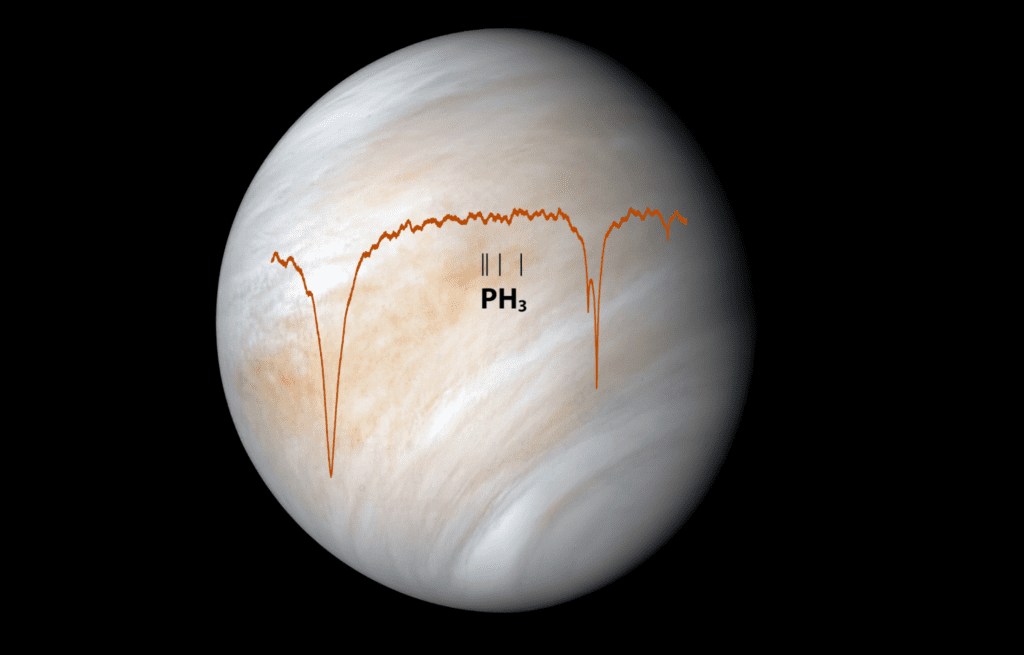
Which is why the 2020 detection of phosphine (PH₃) in Venus’s clouds was so jarring. Phosphine is a reduced phosphorus compound. Venus’s atmosphere is strongly oxidizing — phosphine should be rapidly destroyed by the available chemistry. For it to persist, something must be continuously replenishing it. On Earth, that something is overwhelmingly biology (or industrial synthesis, which Venus lacks).
Four years later, the detection of phosphine in Venus’s atmosphere has survived all challenges and acquired independent support from archival data. The presence of phosphine in Venus’s oxidizing environment is perplexing, and comprehensive studies rule out all known abiotic sources. More data is needed to understand the origin of phosphine.
In July 2024, researchers went further. Recent findings presented at a national astronomy meeting have intensified the debate about the potential for life in the clouds of Venus. Researchers reported the detection of phosphine and tentative signs of ammonia in the planet’s atmosphere, which could indicate the presence of microbial life.
And in early 2025, the signal was independently corroborated. Four years after the original discovery, new confirmation of phosphine emerged, suggesting there might be life — or at the very least new chemistry — in the extreme environment of Venus.
A systematic analysis reviewed every potential non-biological phosphine production pathway for Venus — gas phase reactions, surface and subsurface geochemistry, photochemistry, and other non-equilibrium processes. The conclusion: none of these potential production pathways is sufficient to explain the observed abundance. The source remains either unknown geo/photochemistry — implying our understanding of Venus’s chemistry is significantly incomplete — or aerial microbial biology.
It’s important to be precise here: this is not evidence of life. It’s evidence of something we can’t explain — which is a very different thing, but also not nothing. The Venus phosphine situation is a legitimate unsolved scientific problem, not a tabloid sensation.
ESA’s JUICE spacecraft made a Venus flyby in August 2025 carrying instruments that could potentially detect phosphine. Whether JUICE’s instruments were switched on and deployed at Venus remains unclear — the engineers were being cautious about activating instruments mid-flight. NASA’s DAVINCI mission, targeting a late-2020s launch, will descend directly through Venus’s cloud layers and will be better positioned to settle the question.
5. Quantum Tunneling — Particles That Apparently Ignore the Speed Limit
The core problem: When particles quantum mechanically tunnel through energy barriers, measurements consistently show transit times that suggest superluminal speeds. Six decades of experiments reproduce this effect.
One of the stranger corners of quantum mechanics is the tunneling effect. A particle — say, an electron — encounters an energy barrier it classically shouldn’t be able to cross. In quantum mechanics, its wave function extends through the barrier, giving it a non-zero probability of appearing on the other side. This isn’t theoretical speculation: it’s why tunnel diodes work, why nuclear fusion happens in stars, why scanning tunneling microscopes can image individual atoms.
The strange part is how long it takes. In the six decades since Hartman’s paper, no matter how carefully physicists have redefined tunneling time or how precisely they’ve measured it in the lab, they’ve found that quantum tunneling invariably exhibits the Hartman effect. Tunneling seems to be incurably, robustly superluminal.
The Hartman effect: as a barrier gets thicker, the tunneling time stops increasing proportionally. It saturates. At sufficiently thick barriers, the “speed” implied by the transit time exceeds the speed of light. This isn’t a statistical glitch — it’s been reproduced in photon tunneling experiments, electron tunneling experiments, and atomic beam experiments across multiple decades and multiple countries.
Does this violate relativity? Physicists generally argue no — you can’t actually send information faster than light via tunneling, because the effect involves the reshaping of wave packets rather than classical particle travel. Physicists Patrik Schach and Enno Giese from TU Darmstadt propose that the tunneling particle actually experiences a slight temporal delay compared to a reference, which contradicts previous experiments that attributed superluminal speed to tunneling. Their proposed experiment — using atoms as clocks via Ramsey interferometry — aims to settle the question with a time measurement on the order of 10⁻²⁶ seconds.
Quantum tunneling does not allow faster-than-light communication or causality violation. What “superluminal” means here is subtle and depends on how you define “tunneling time” — a question that remains genuinely contested in physics. What’s not contested is that the Hartman effect is real and reproducible.
6. The Quantum Tardigrade — Life Brushes Against the Quantum World
The core problem: A team placed a living tardigrade (water bear) on a superconducting qubit at near absolute zero. The system showed behavior consistent with entanglement. Scientists disagree sharply about what this actually demonstrates.
Tardigrades are extraordinary organisms — microscopic animals that can survive vacuum, radiation, extreme temperatures, and desiccation through a suspended animation state called cryptobiosis. They’ve been to space. They’ve survived conditions that kill everything else. They’re also, as of 2021, at the center of one of the more contentious claims in recent quantum physics.
Researchers placed a tardigrade in cryptobiosis on a superconducting qubit at temperatures below 10 millikelvin — near absolute zero. The tardigrade was coupled with the qubit, and a highly entangled state between this combined system and another qubit was prepared. The animal then returned to its active form after 420 hours at sub 10 mK temperatures and pressure of 6×10⁻⁶ mbar, setting a new record for conditions a complex form of life can survive.
The team concluded the tardigrade was, in some sense, entangled with the quantum system. “While one might expect similar physical results from inanimate objects with similar composition to the tardigrade, we emphasize that entanglement is observed with an entire organism that retains its biological functionality post experiment,” the team concluded.
The response from other physicists was immediate and largely skeptical. Douglas Natelson of Rice University wrote that the change in resonance frequency was “not entanglement in any meaningful sense,” and that “the tardigrade is no more entangled with the qubits than the underlying silicon chip.”
The truth is probably somewhere in between. The tardigrade demonstrably altered the quantum circuit’s properties — that’s real. Whether that constitutes “entanglement” in the technically meaningful quantum sense is a definitional question that the experiment, as designed, can’t fully settle. What it does do is open a genuinely interesting avenue: what happens at the intersection of living matter and quantum systems? That’s a question worth pursuing carefully, without overclaiming.
7. Mars Leopard Spots — Biology’s Chemical Signature on a Dead World?
The core problem: NASA’s Perseverance rover found a rock with chemical and structural features that on Earth are almost exclusively associated with microbial activity. The rock is ~3.5 billion years old, from when Mars had liquid water.
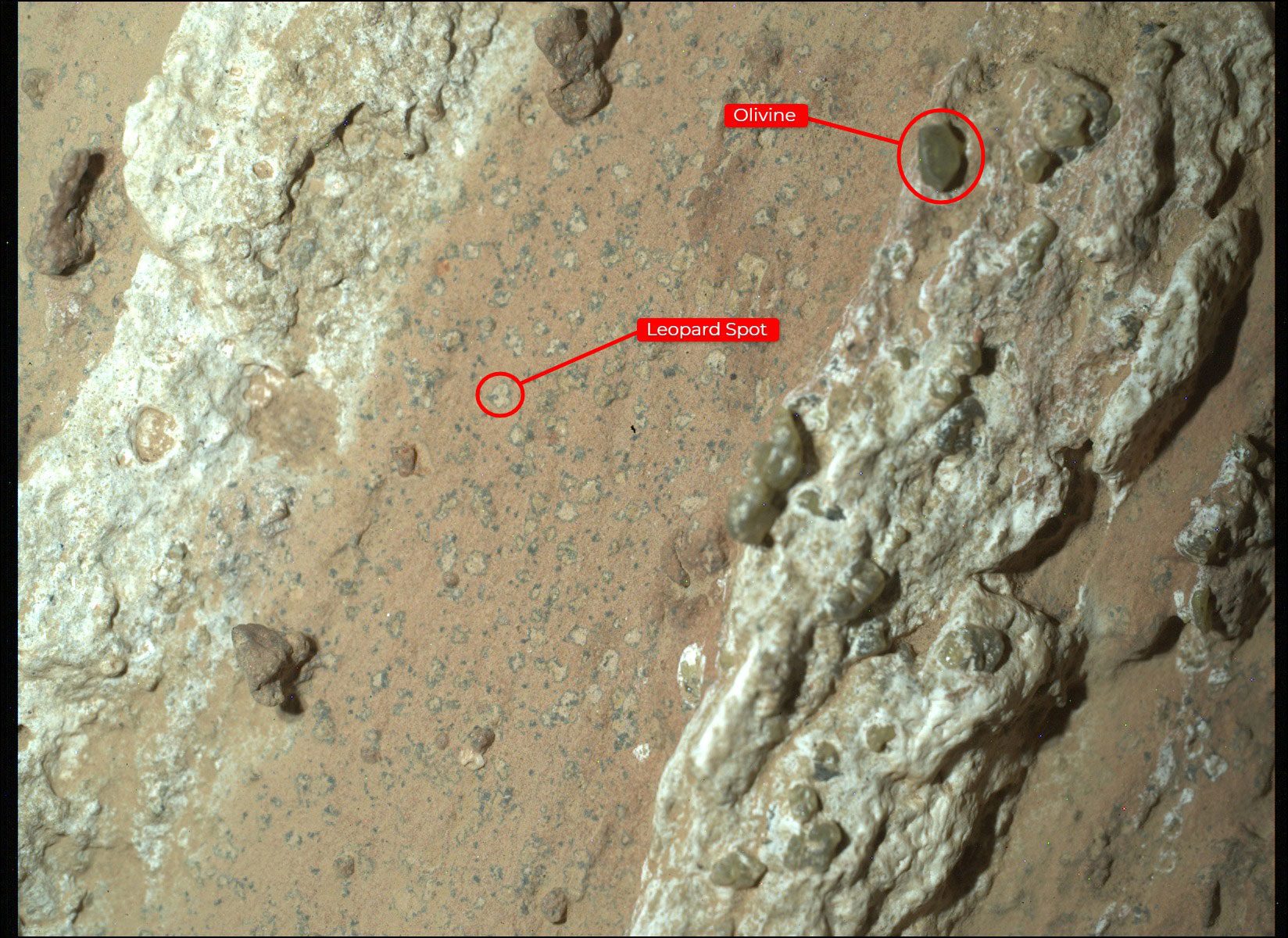
In July 2024, Perseverance was exploring the Bright Angel formation in Jezero Crater — a site geologists believe was once an ancient lake delta — when it spotted something unusual on a rock since nicknamed “Cheyava Falls.” White spots with black rings, laced with iron phosphate. On Earth, such structures appear alongside ancient microbial communities. They’re not a guarantee of life — but they’re a flag that, anywhere on Earth, would send astrobiologists running for sample containers.
In 2025, researchers announced they’d identified the Cheyava Falls markings as minerals and textures that on Earth are often associated with microbial activity — a strong indication that once there might possibly have been life on Mars, though other non-biological explanations do exist and can’t yet be ruled out.
Perseverance’s 2024–25 work in Jezero Crater’s Bright Angel formation turned up organic signatures and odd ringed “leopard spots,” alongside minerals like vivianite and greigite that on Earth can be tied to microbial processes.
The rock has been cached. If the Mars Sample Return mission proceeds (it’s currently in budget uncertainty limbo), Earth-based labs with instruments far more sophisticated than anything Perseverance carries will have the chance to look for biological signatures directly. That’s the only way this question gets definitively answered.
The honest framing: Cheyava Falls is genuinely interesting, not definitively biological. On a planet with complex geology and chemistry, there are abiotic pathways to similar-looking structures. But the combination of features — organic chemistry, iron sulfide minerals, ringed spot morphology — is unusual enough that serious scientists are taking it seriously.
What These Anomalies Actually Tell Us
Reading this kind of list, there’s a temptation to either dismiss the whole thing (“scientists are always finding anomalies that turn out to be nothing”) or to overcorrect (“everything we know is wrong”). Both reactions are lazy.
The more accurate picture is messier and more interesting. Science’s standard models — ΛCDM cosmology, the Standard Model of particle physics — have been extraordinary successes. They’ve made precise predictions confirmed to many decimal places. The fact that they’re now showing cracks in a handful of specific places doesn’t mean they’re useless; it means they’re probably incomplete.
Most anomalies in the history of physics turned out to be systematic errors, miscalculations, or measurement artifacts. But some — the photoelectric effect, the precession of Mercury’s perihelion, the CMB’s unexpected uniformity — turned out to be pointing at something new. You can’t know which category you’re in until you’ve done the hard work.
What’s different about the anomalies listed here is their persistence. The Hubble Tension has now been confirmed by multiple independent methods across a decade, has survived JWST’s precision improvements, and keeps strengthening rather than fading. The muon g-2 discrepancy ran through six years of increasingly precise experiments at Fermilab. Venus phosphine has been scrutinized by multiple teams who’ve systematically eliminated known abiotic explanations. These aren’t one-time oddities — they’re stubborn.
The physicist Lee Smolin once described cosmology’s current moment as analogous to astronomy in 1900 — sitting on data that didn’t fit the existing framework, a few years before a paradigm shift that nobody quite expected. That might be overstated. Or it might not be. The honest answer is that we don’t know yet, and intellectual honesty requires sitting with that uncertainty rather than rushing to a comfortable conclusion in either direction.
If any of these anomalies survive the decade — if the Hubble Tension persists at 5–6 sigma through the next generation of surveys, if JWST continues finding galaxies that models can’t explain even after every reasonable adjustment — then we’re probably looking at something genuinely new. Not the collapse of physics. An extension of it.
That’s happened before. It’s actually how physics works.
Frequently Asked Questions
Is the Hubble Tension definitely evidence of new physics, or could it be a measurement error?
As of 2025/2026, it’s genuinely unknown. The leading candidates are: (1) a systematic error in the distance ladder that JWST hasn’t found yet, (2) early dark energy changing the pre-CMB expansion rate, or (3) genuinely new physics beyond ΛCDM. The fact that JWST confirmed Cepheid measurements rather than explaining the tension makes option 1 less likely than it was three years ago. Options 2 and 3 remain live possibilities. The 6-sigma significance makes a simple coincidence extremely unlikely, but science proceeds on confirmation, not probability alone.
Does the muon g-2 result prove there’s new physics beyond the Standard Model?
No — not definitively. The experimental measurement (127 parts-per-billion precision, Fermilab 2025) is settled. The question is which theoretical prediction to compare it to. The lattice QCD prediction agrees with the experiment; the traditional data-driven prediction shows a discrepancy. Until the theory community resolves its internal disagreement, we can’t say with certainty whether the muon is showing us new physics. What we can say is that the experimental result provides a stringent benchmark for any theory that tries to extend the Standard Model.
Has the Venus phosphine detection been confirmed or debunked?
Neither fully. The signal has survived years of scrutiny and been corroborated by independent analysis of archival Pioneer Venus data. Multiple teams have also failed to eliminate all known abiotic sources for the detected phosphine abundance. However, the detection remains controversial because the initial radio telescope data required substantial reprocessing, and not all researchers agree on the signal’s strength. The honest status in 2026: the detection is probably real, its source is unknown, and definitive answers await in-situ atmospheric missions.
Do JWST’s early galaxies actually break cosmology?
Not quite, but they’ve forced significant revisions to galaxy formation models. Initial media coverage overstated the crisis. After accounting for modified star formation efficiencies, top-heavy initial mass functions, and AGN contributions, many “impossible” galaxies become less impossible — though some anomalies persist. The Big Wheel spiral galaxy and the non-spinning galaxy found in May 2026 remain harder to explain away. The field is actively working through this; it’s a productive crisis, not a dead end.
Can quantum tunneling actually transmit information faster than light?
No — and this is worth being clear about. While the Hartman effect is real (tunneling transit times don’t increase proportionally with barrier thickness, implying apparent superluminal speeds), you cannot use tunneling to send information faster than light. The information-carrying part of a signal — the “front” of the wave — always travels at or below light speed. The apparent superluminality involves the peak of a wave packet, which doesn’t carry new information. Relativity is safe. The phenomenon is still genuinely weird and not fully understood at a deeper level.
Was the tardigrade really quantum entangled?
This is primarily a definitional dispute among physicists. The tardigrade demonstrably altered the resonance frequency of the superconducting qubit system — that’s real and reproducible. Whether this constitutes “entanglement” in the meaningful quantum sense, or whether it’s simply a classical dielectric interaction that shifted the qubit’s properties, is what experts disagree on. Most physicists who commented publicly were skeptical of the “entanglement” framing, while acknowledging the experiment itself was well-executed. The paper has not been peer-reviewed as of 2026.
What’s the best evidence for life on Mars from the Cheyava Falls rock?
The rock displays a combination of features that, on Earth, are associated with ancient microbial activity: organic chemical signatures, vivianite and greigite minerals linked to microbial processes, and the distinctive ringed “leopard spot” morphology. No single feature proves biology; the combination is what makes it interesting. Non-biological explanations exist for each feature individually. The definitive test requires Earth-based laboratory analysis of the cached sample — which awaits a Mars Sample Return mission that is currently uncertain in both timeline and funding.
Why do these anomalies matter if they might all have mundane explanations?
Because “mundane” doesn’t mean unimportant. If the Hubble Tension resolves into early dark energy, that’s genuinely new physics. If the muon discrepancy resolves by exposing an error in hadronic vacuum polarization calculations, that’s important progress in quantum chromodynamics. And if any of these anomalies turns out to be irreducible — genuinely requiring a new framework — then we’re at an inflection point in fundamental science. Even false positives, when properly investigated, teach you something real about the universe.
When might we get answers to some of these?
The Hubble Tension should become clearer over the next 3–5 years as DESI, Euclid, and JWST accumulate more data. The muon g-2 theory dispute may resolve within 1–2 years as lattice QCD computations improve. Venus phosphine could be partially clarified by the JUICE flyby data (2025, awaiting analysis) and substantially by DAVINCI (late 2020s launch). Mars sample return, if funded, is currently targeting the mid-2030s. The JWST galaxy formation puzzle will likely be progressively addressed as spectroscopic follow-up on more early galaxies accumulates over the next few years.
Are there other major anomalies not covered here?
Yes. The “S8 tension” (structure growth in the universe also doesn’t match ΛCDM predictions well). The anomalous Antarctic Impulse Transient Antenna (ANITA) detections — cosmic ray-like particles that appeared to travel upward through Earth, which shouldn’t happen. Long COVID’s mechanisms still defy clean explanation. Dark matter has been definitively detected gravitationally for decades but has never been found in any lab detector. These deserve their own deep dives.
Explore More on FutureNow.click
These Scientific Phenomena Defy Logic — And Scientists Still Can’t Explain Them
25 Strange Science Facts That Scientists Still Can’t Explain
Weird Scientific Mysteries Scientists Still Don’t Understand
Could time travel exist as a secret? 7 Clues for 2025
We Live in a Simulation: Weird Physics Theory Suggests